> For the complete documentation index, see [llms.txt](https://docs.mailtrap.io/llms.txt). Markdown versions of documentation pages are available by appending `.md` to page URLs; this page is available as [Markdown](https://docs.mailtrap.io/guides/sdk/dotnet-integration.md).
# .NET
Learn how to integrate Mailtrap with .NET apps and projects for email sending using SDK, SMTP, or RESTful API.
Mailtrap .NET SDK on GitHub
### Overview
Mailtrap can be integrated with .NET apps and projects for email sending.
### Email API/SMTP for .NET
#### SDK integration
The [Mailtrap .NET SDK](https://github.com/mailtrap/mailtrap-dotnet) is a modern, async-first library for sending transactional and bulk emails from .NET applications. The SDK supports:
* Transactional email sending
* Batch email sending
* Template management
* Contact management
* Sandbox testing
* Account management
* Async/await pattern support
* .NET 6+, .NET Core, and .NET Framework
### Installation
Install the SDK using NuGet Package Manager:
{% code title=".NET CLI" %}
```bash
dotnet nuget add source https://nuget.pkg.github.com/mailtrap/index.json --name github-mailtrap --username GITHUB_USERNAME --password GITHUB_PAT --store-password-in-clear-text
dotnet add package Mailtrap -v 3.0.0 -s github-mailtrap
```
{% endcode %}
### Minimal Example
Here's a minimal example to send your first email:
{% code title="Program.cs" %}
```csharp
using Mailtrap;
using Mailtrap.Emails.Models;
using Mailtrap.Emails.Requests;
using var mailtrapClientFactory = new MailtrapClientFactory("YOUR_API_KEY");
var client = mailtrapClientFactory.CreateClient();
var mail = new SendEmailRequest
{
From = new EmailAddress("sender@yourdomain.com"),
To = new[] { new EmailAddress("recipient@example.com") },
Subject = "Hello from Mailtrap",
TextBody = "Welcome to Mailtrap Email API!"
};
await client.Email().Send(mail);
```
{% endcode %}
{% hint style="info" %}
Get your API token from your Mailtrap account under **Settings → API Tokens**.
{% endhint %}
#### SMTP integration
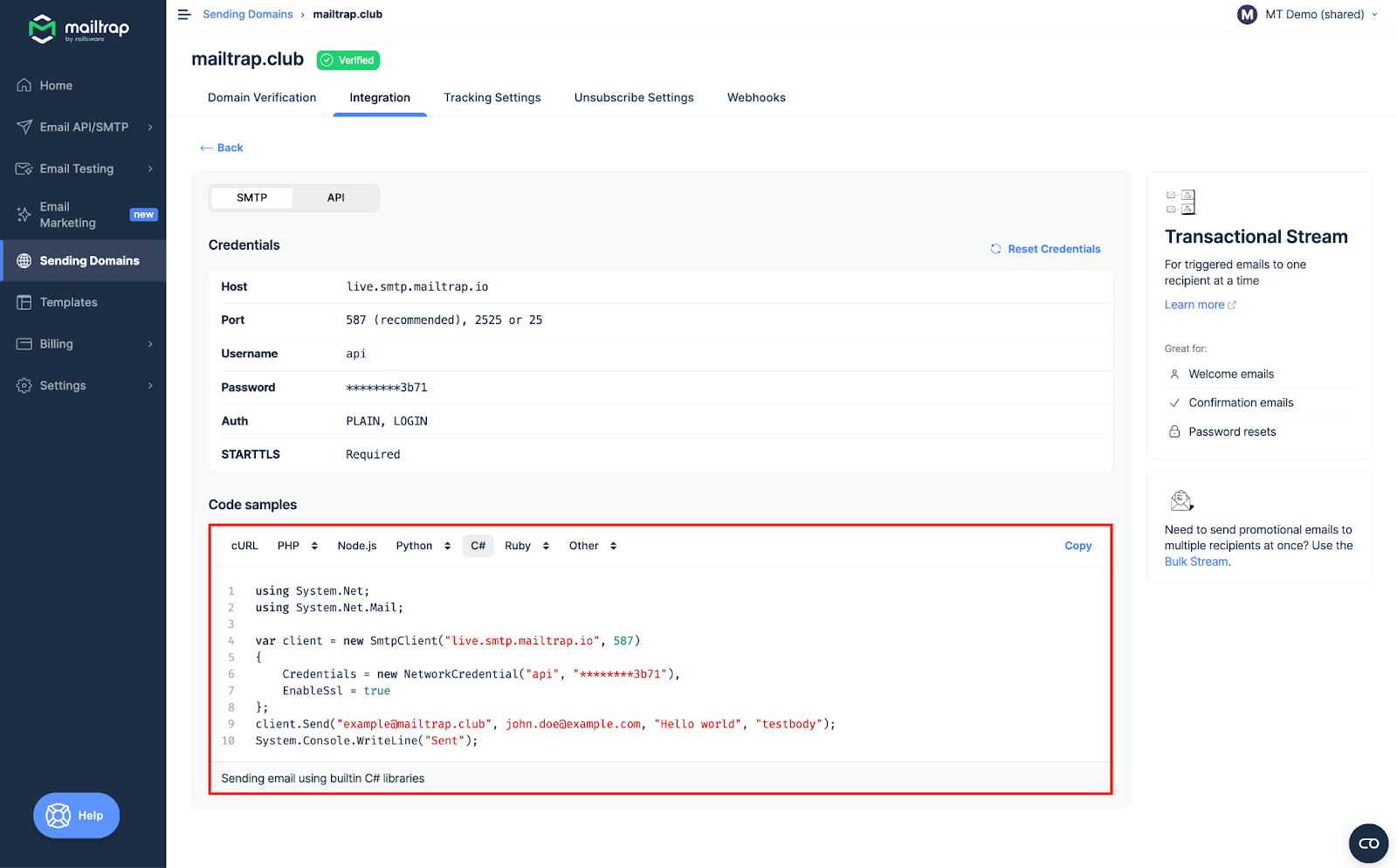
To integrate SMTP with your .NET app, navigate to the Integrations tab, choose C#, and copy-paste the credentials or ready-made code snippets.
{% hint style="info" %}
SMTP integration is compatible with any .NET programming language or library that sends emails via SMTP.
{% endhint %}
Read more about SMTP integration [here](/email-api-smtp/setup/smtp-integration.md).
#### RESTful API integration
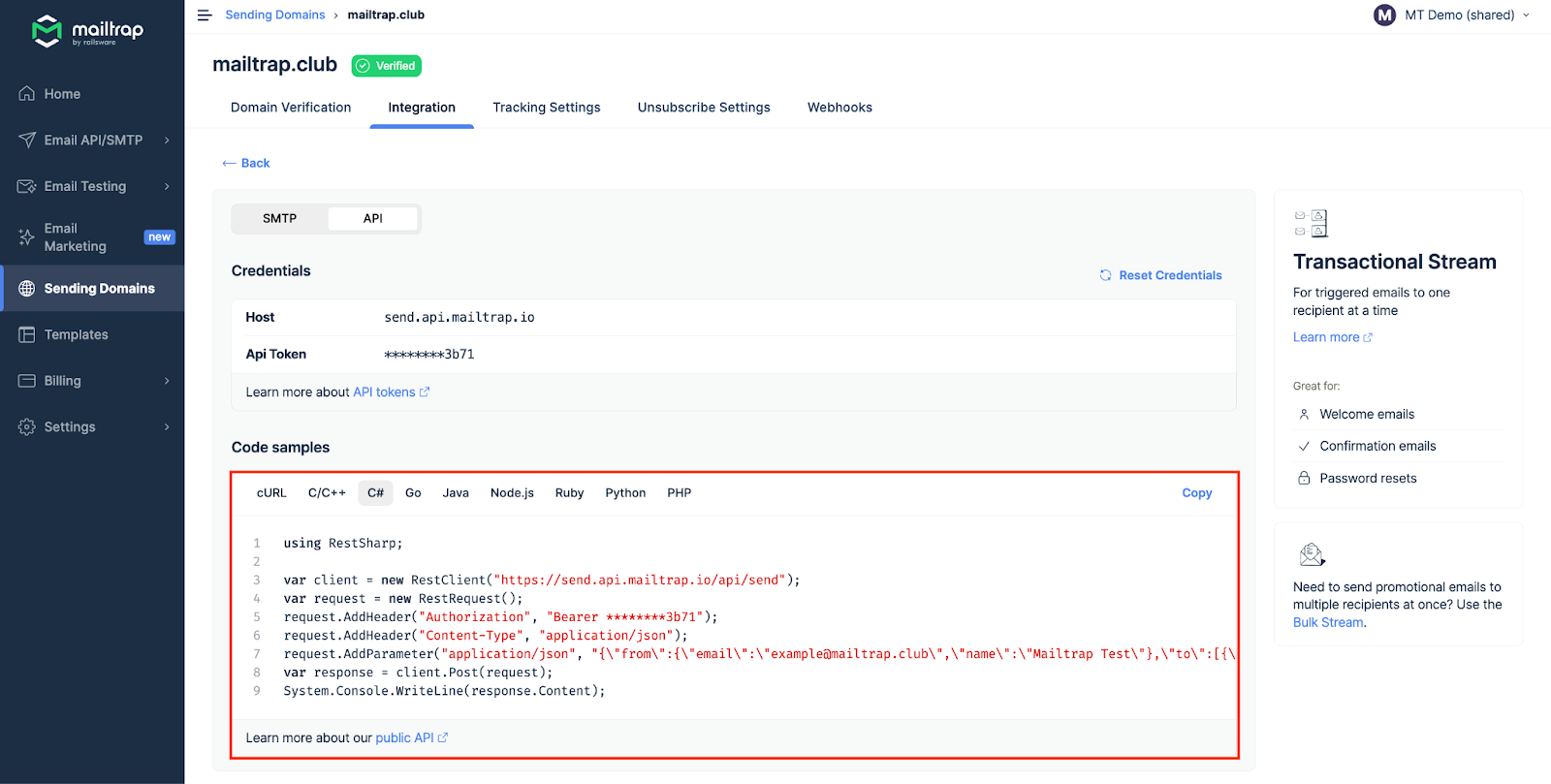
To integrate Mailtrap using RESTful API, use the configuration available among **Code samples** under the API section.
API integration can be used with any .NET programming language or library that supports HTTP requests. For more details, refer to the [API documentation](https://api-docs.mailtrap.io/docs/mailtrap-api-docs/5tjdeg9545058-mailtrap-api).
Read more about API integration [here](/email-api-smtp/setup/api-integration.md).
---
# Agent Instructions
This documentation is published with GitBook. GitBook is the documentation platform designed so that both humans and AI agents can read, navigate, and reason over technical content effectively. Learn more at gitbook.com.
## Querying This Documentation
If you need additional information that is not directly available in this page, you can query the documentation dynamically by asking a question.
Perform an HTTP GET request on the current page URL with the `ask` query parameter, and the optional `goal` query parameter:
```
GET https://docs.mailtrap.io/guides/sdk/dotnet-integration.md?ask=&goal=
```
`ask` is the immediate question: it should be specific, self-contained, and written in natural language.
`goal` is optional and describes the broader end goal you are ultimately trying to accomplish on behalf of the user. GitBook uses it to tailor the answer towards what is most useful for that goal.
The response will contain a direct answer to the question and relevant excerpts and sources from the documentation.
Use this mechanism when the answer is not explicitly present in the current page, you need clarification or additional context, or you want to retrieve related documentation sections.