> For the complete documentation index, see [llms.txt](https://docs.mailtrap.io/llms.txt). Markdown versions of documentation pages are available by appending `.md` to page URLs; this page is available as [Markdown](https://docs.mailtrap.io/guides/ai-powered-integrations/qodo.md).
# Qodo
[Qodo](https://qodo.ai/) is an AI code review platform that gives engineering teams deep codebase context to move faster without sacrificing code quality. In this guide, you’ll learn how to integrate it with Mailtrap MCP.
And keep in mind that, you can use your AI agent to help you integrate Mailtrap or even migrate from another email service provider.
**Note**: Mailtrap offers a free, 4000 email/month Email API and SMTP plan.
### Prerequisites
Before you start, make sure to:
* Set up your [sending domain](https://docs.mailtrap.io/email-api-smtp/setup/sending-domain) (this takes approximately 5 minutes).
* Install the [latest Node.js version](https://nodejs.org/en) since [Mailtrap MCP](https://www.npmjs.com/package/mcp-mailtrap) is implemented as a Node.js command line utility.
* Install or update the IDE you’re using for Qodo.ai to the latest version.
### Step 1. Add Mailtrap MCP to Qodo.ai
First, open Qodo.ai from your preferred IDE. This can be VS Code, JetBrains IDEs, etc. For the purposes of this guide, we’ll use VSC.
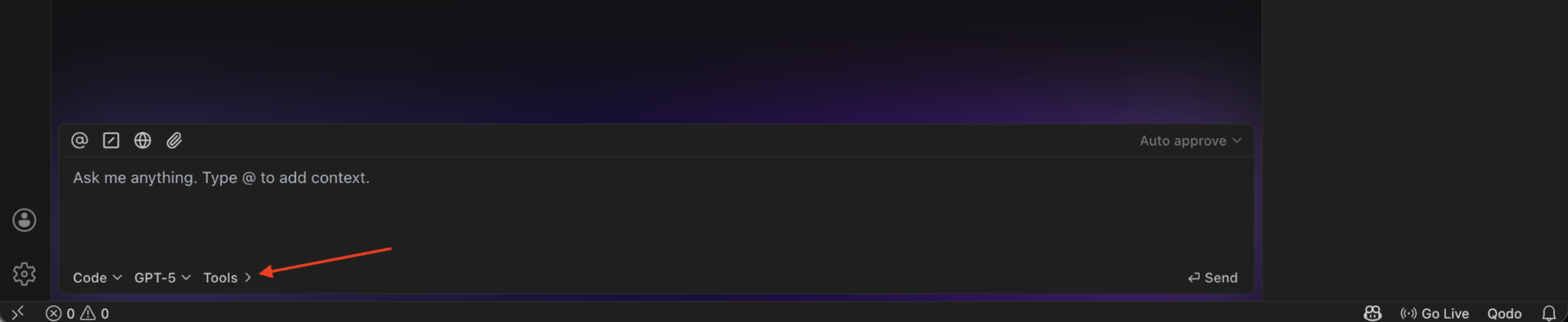
Next, click on the **Tools** button right above the Qodo AI chatbox.
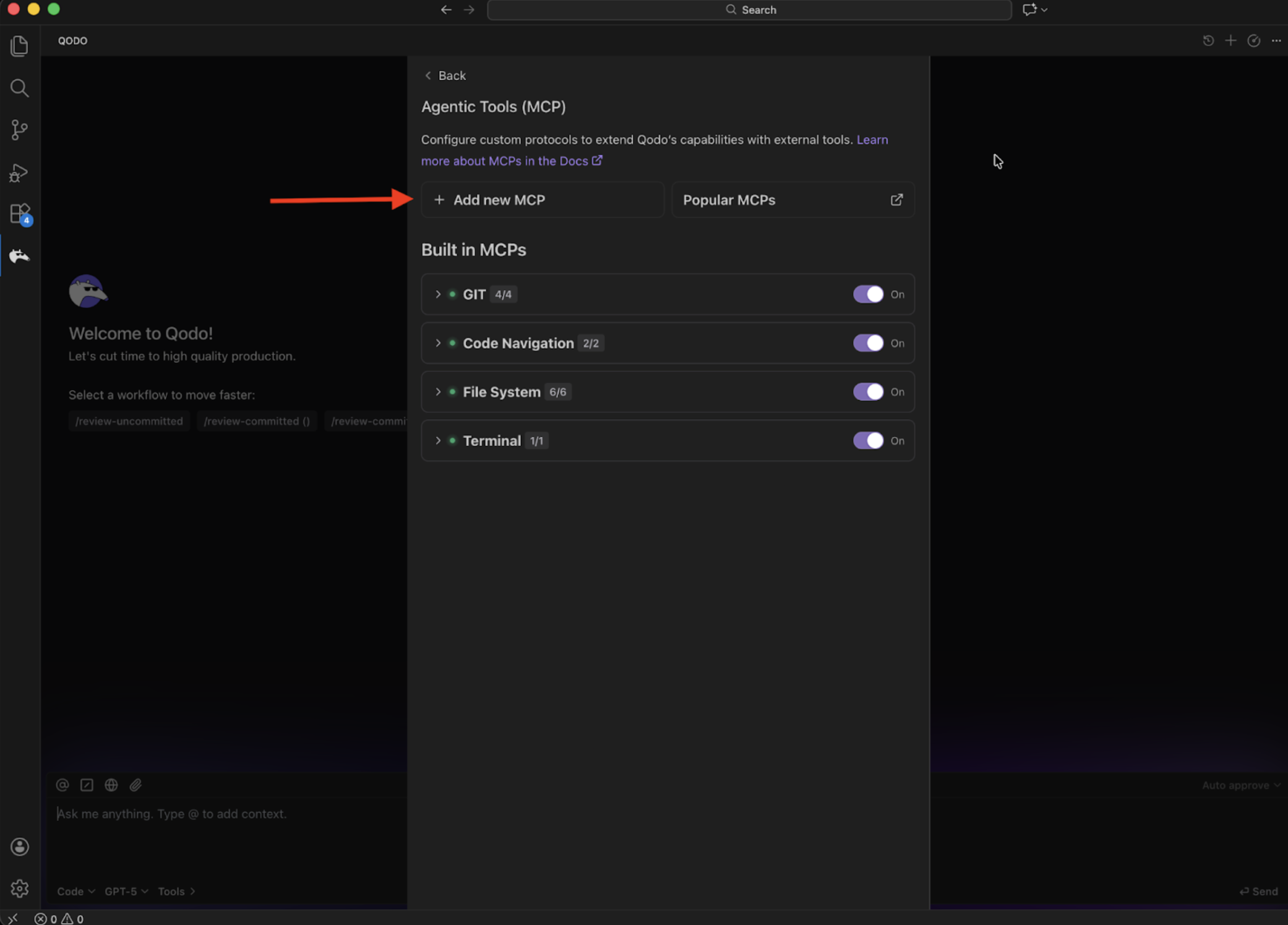
Then, click on + **Add new MCP**.
Once the following window appears after you click on **Add new MCP**, copy/paste the following code snippet:
```json
{
"mcpServers": {
"mailtrap": {
"command": "npx",
"args": ["-y", "mcp-mailtrap"],
"env": {
"MAILTRAP_API_TOKEN": "your_mailtrap_api_token",
"DEFAULT_FROM_EMAIL": "your_sender@example.com",
"MAILTRAP_ACCOUNT_ID": "your_account_id",
"MAILTRAP_TEST_INBOX_ID": "your_test_inbox_id"
}
}
}
}
```
### Step 2. Insert Mailtrap API credentials
Next, all you need to do is replace the following values in the **settings.json** file:
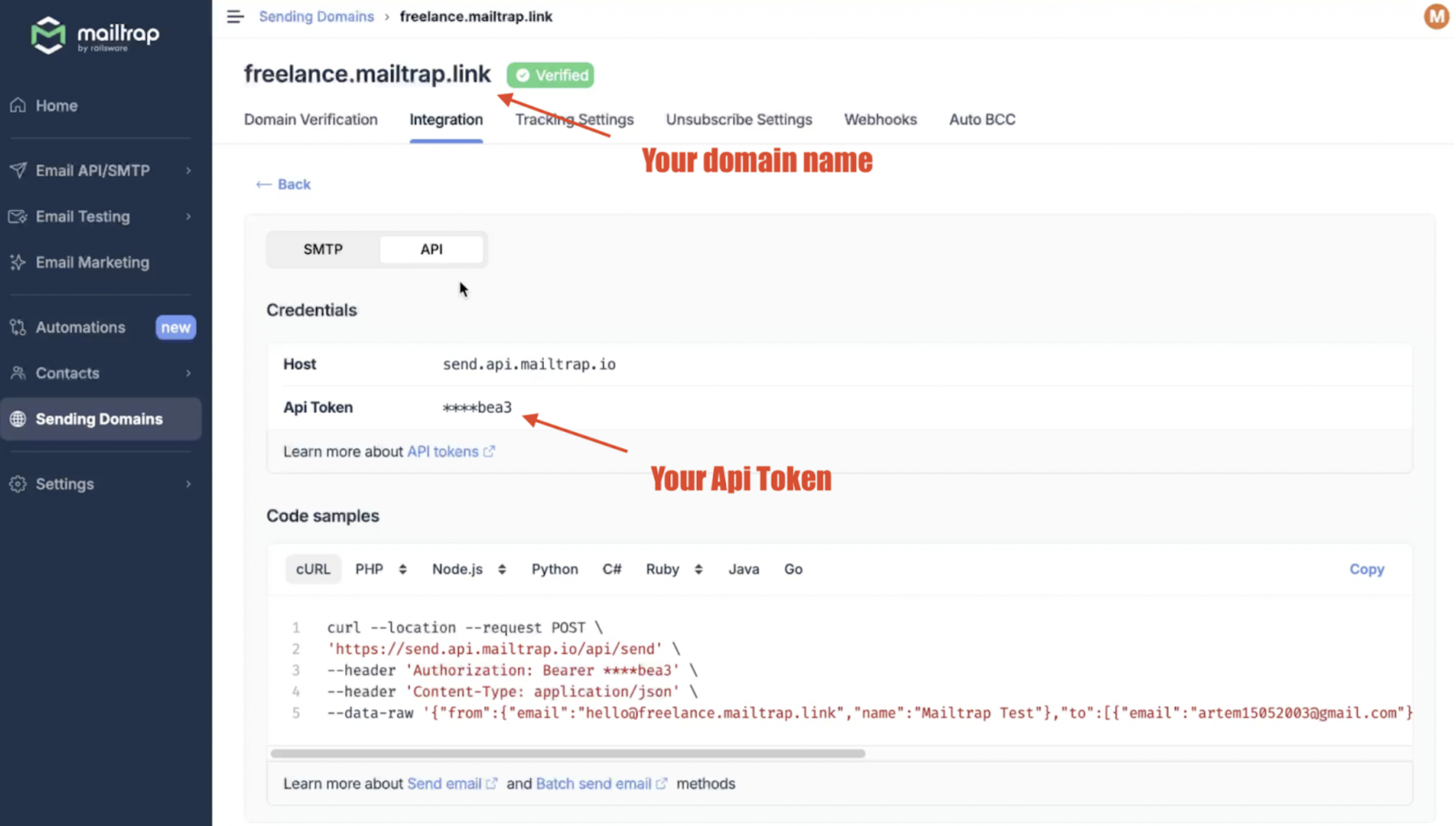
* `MAILTRAP_API_TOKEN` – Required for all functionality, used to authenticate API requests, which you can copy/paste from the credentials tab.
* `DEFAULT_FROM_EMAIL` – Required for email sending. Make sure the email’s domain matches your own domain from the **Sending Domains** tab in Mailtrap.
You can find these credentials in your Mailtrap account by navigating to **Sending Domains** → **Integration** → **API**.
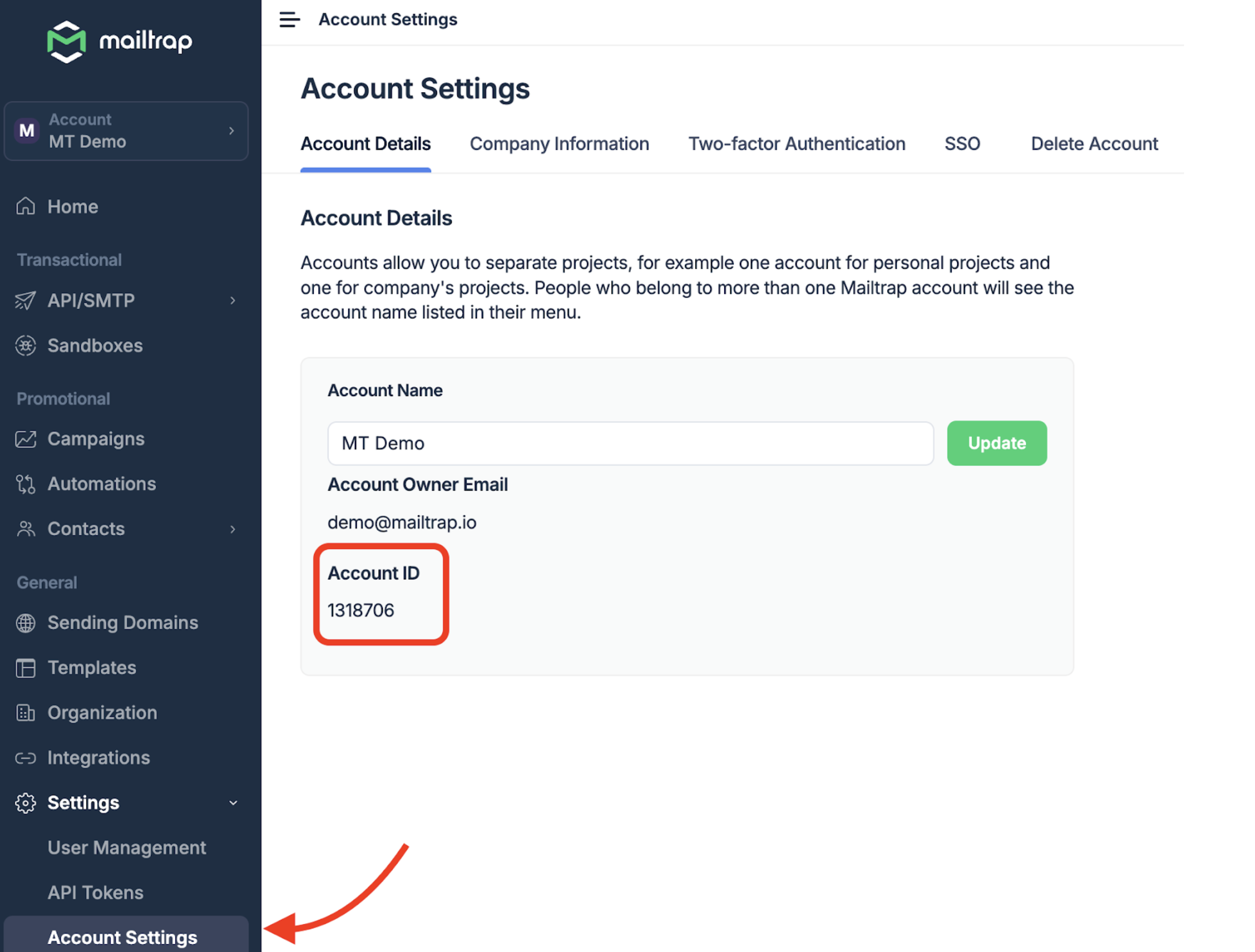
* `MAILTRAP_ACCOUNT_ID` – This is required for template management purposes. You can find the account ID under **Settings** → **Account Settings**.
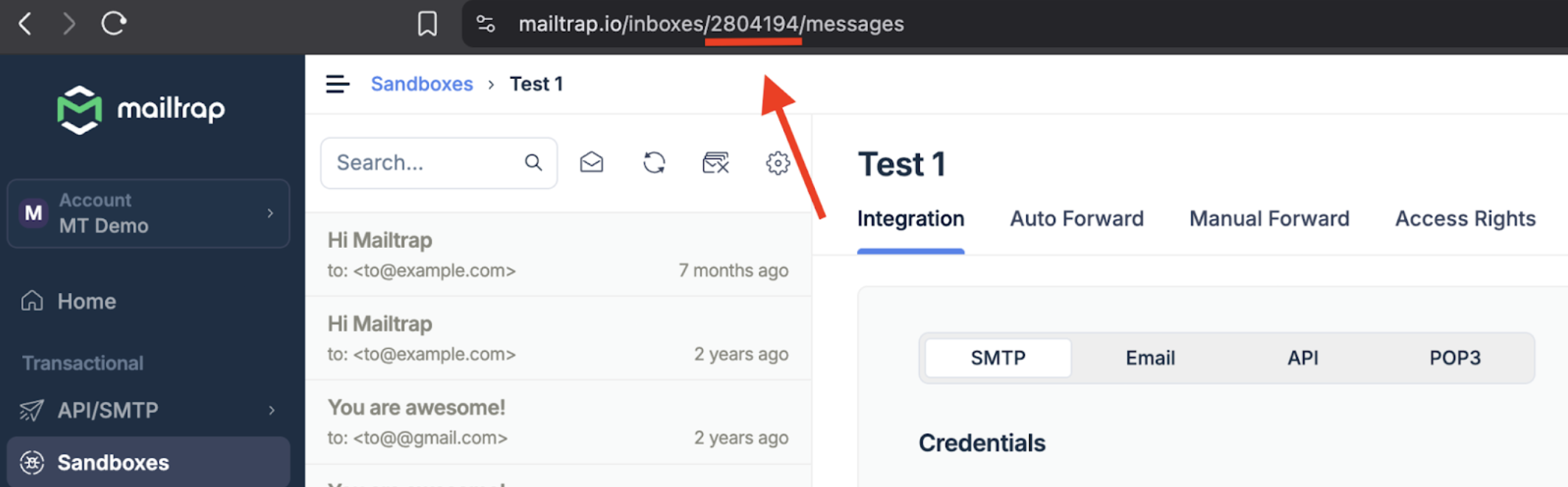
* `MAILTRAP_TEST_INBOX_ID` – If you need sandbox email functionality, you can find this ID in your Sandbox.
### Qodo.AI + Mailtrap MCP server possible use cases
#### Sandbox operations during code review
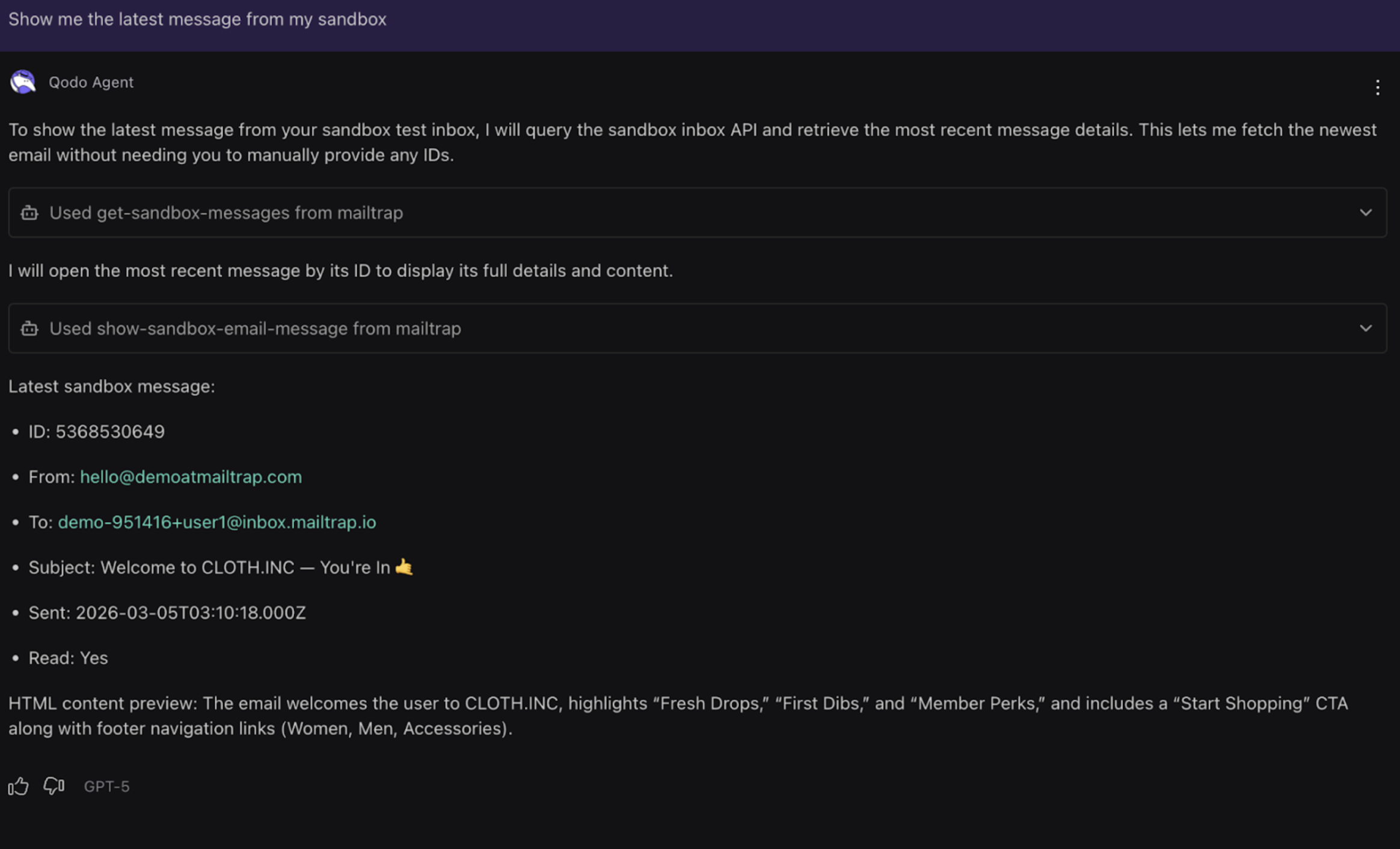
Imagine that you’re reviewing a part of the code responsible for sending emails and that you’re working in a staging environment using [Sandbox](https://mailtrap.io/email-sandbox/).
While reviewing your code, you want to trigger email-sending logic to better understand or verify behavior, test emails, etc.
This is possible from the Qodo agent, which lets you use simple prompts to, among other things:
* Verify what the code actually does without switching to the Mailtrap UI and back to the IDE
* Inspect basic message metadata
* Use the returned message ID to request full message details (content, headers, etc.), and more.
#### Template validation during code review
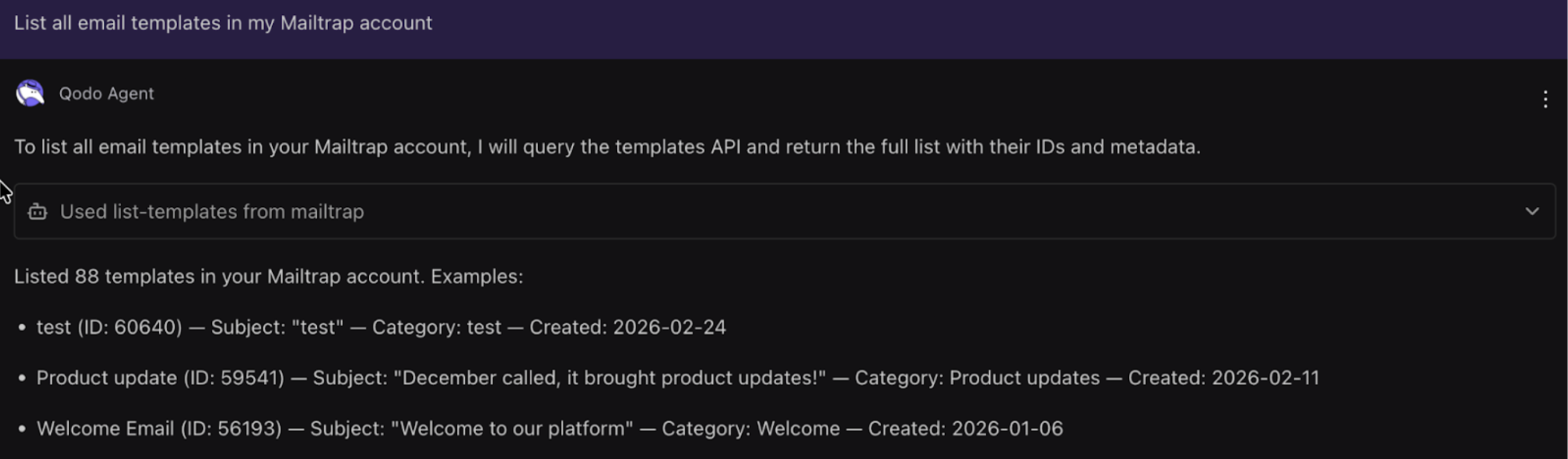
Let’s say that while reviewing code, you notice a Mailtrap template ID being used and you’re unsure whether it’s the correct template.
From the Qodo agent, you can request the list of available templates in the Mailtrap account.
This allows you to quickly confirm that the referenced template is correct, directly within the review flow.
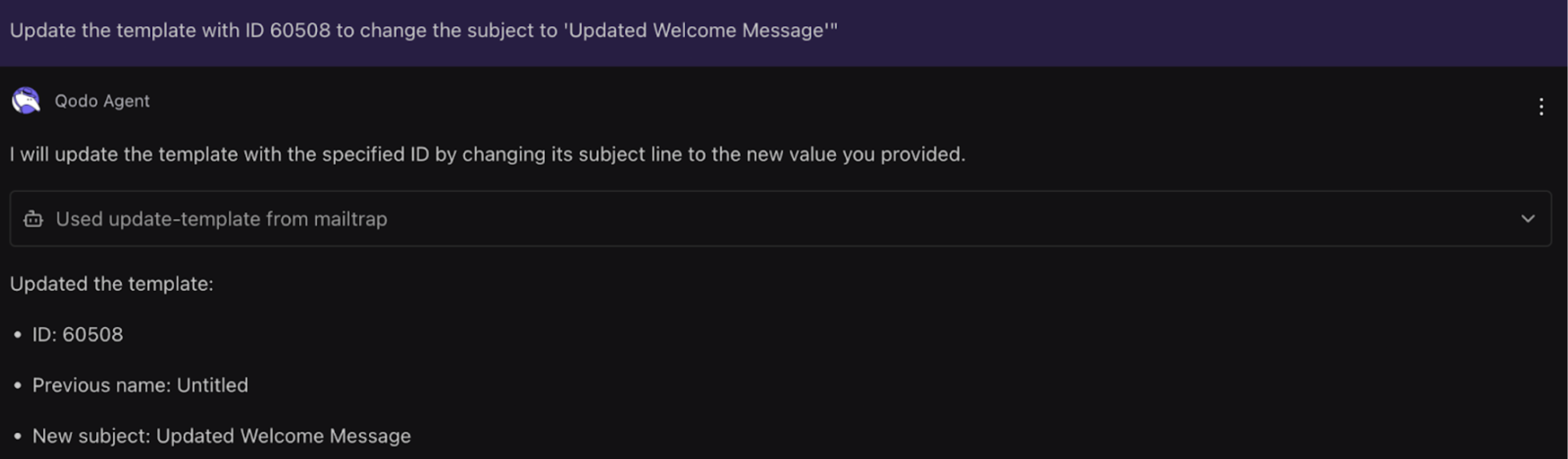
Don’t like the subject line of your template? Tweak it with a simple prompt, just like so:
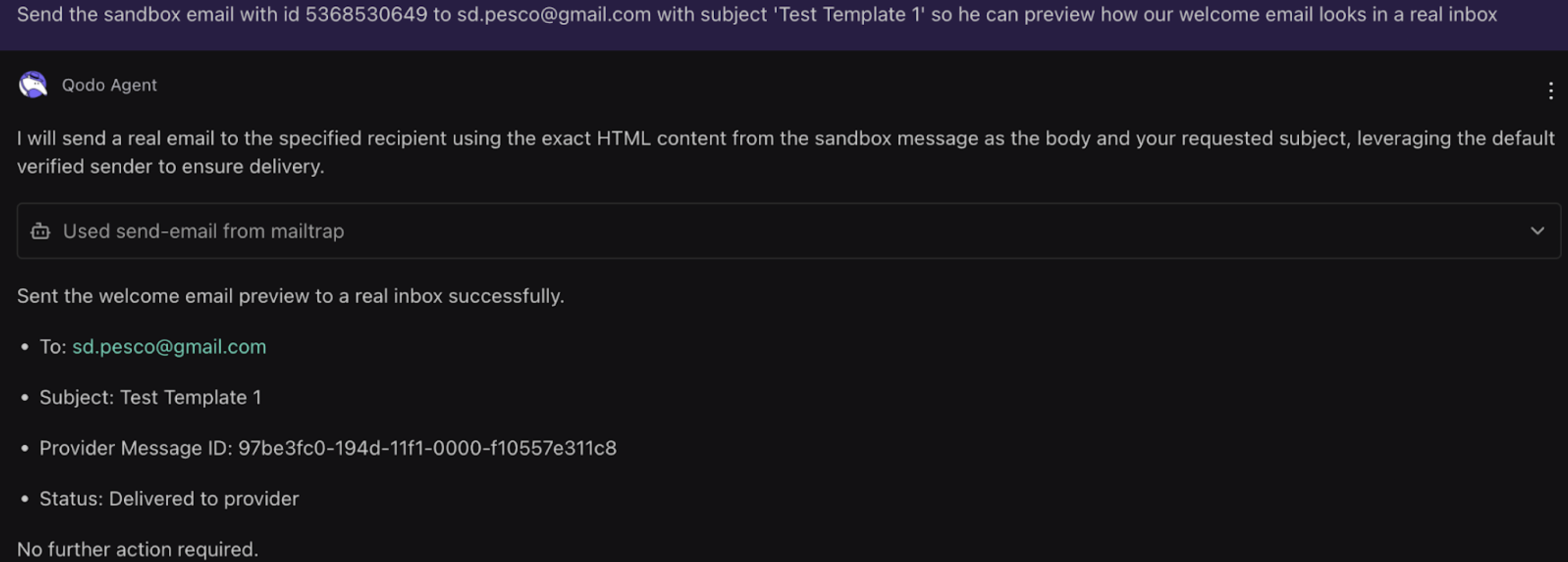
#### Sending emails to your teammate
You’re working on designing an email or a template, and you want your teammate’s opinion.
For this, you can prompt Qodo something like this:
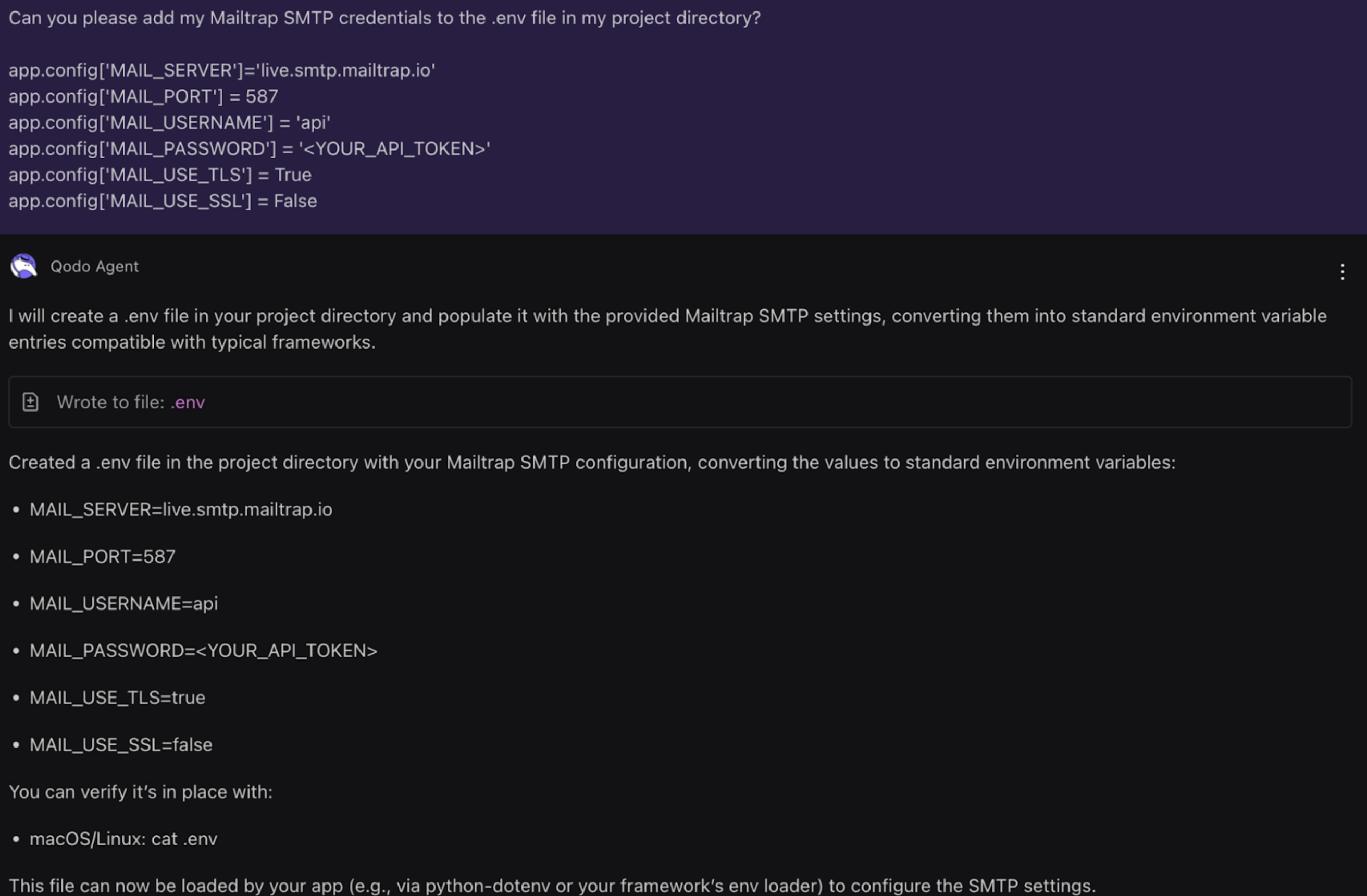
#### Migrating from another email service provider
If you’re migrating from another email service provider or just starting out with Mailtrap, you can ask the Qodo agent to update your credentials so you can start sending emails in no time.
Simply copy/paste the credentials or one of the ready-made code snippets into the chatbox and prompt the AI, like so:
---
# Agent Instructions
This documentation is published with GitBook. GitBook is the documentation platform designed so that both humans and AI agents can read, navigate, and reason over technical content effectively. Learn more at gitbook.com.
## Querying This Documentation
If you need additional information that is not directly available in this page, you can query the documentation dynamically by asking a question.
Perform an HTTP GET request on the current page URL with the `ask` query parameter, and the optional `goal` query parameter:
```
GET https://docs.mailtrap.io/guides/ai-powered-integrations/qodo.md?ask=&goal=
```
`ask` is the immediate question: it should be specific, self-contained, and written in natural language.
`goal` is optional and describes the broader end goal you are ultimately trying to accomplish on behalf of the user. GitBook uses it to tailor the answer towards what is most useful for that goal.
The response will contain a direct answer to the question and relevant excerpts and sources from the documentation.
Use this mechanism when the answer is not explicitly present in the current page, you need clarification or additional context, or you want to retrieve related documentation sections.