> For the complete documentation index, see [llms.txt](https://docs.mailtrap.io/llms.txt). Markdown versions of documentation pages are available by appending `.md` to page URLs; this page is available as [Markdown](https://docs.mailtrap.io/email-api-smtp/deliverability/ip-warmup.md).
# Dedicated IP
Learn about Mailtrap IP warmup: shared vs dedicated IPs, automated IP warmup schedule, and gradual daily sending limits over 3 weeks.
Mailtrap offers both shared IP addresses as well as dedicated IPs.
### Shared IP vs Dedicated IP
A **shared IP** is a default option with nearly all sending providers (including Mailtrap). A provider maintains a pool of IPs that are shared among their users.
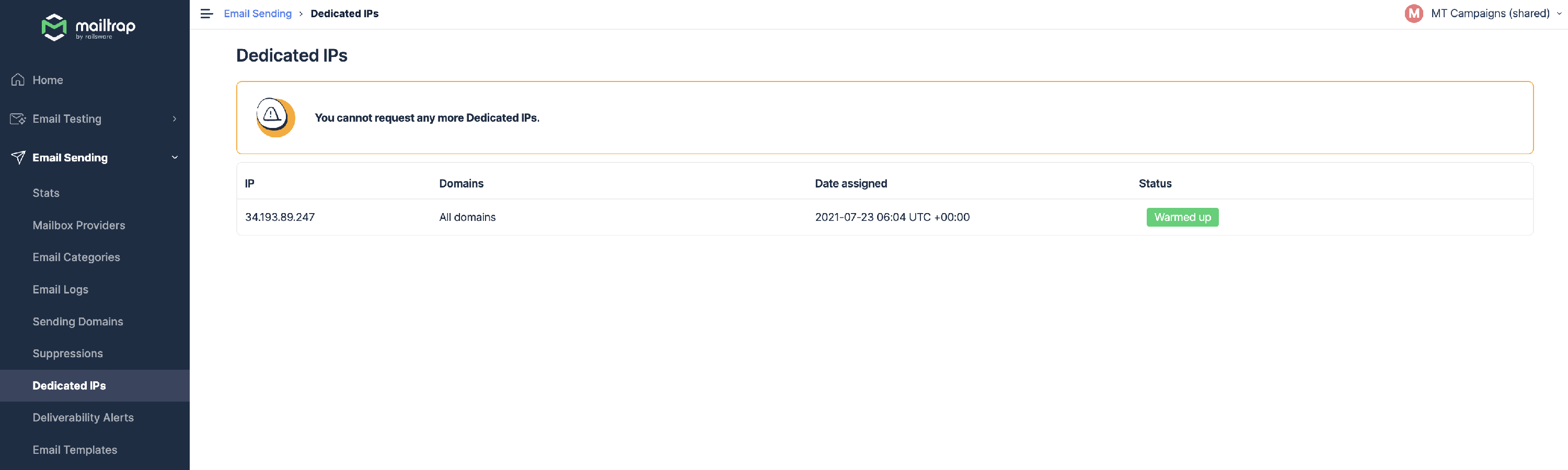
A **dedicated IP** is the IP address that only you use for sending emails. As such, you have full control over your reputation and can influence it with each email sent.
We recommend dedicated IPs only if your volume regularly exceeds 100,000+ emails per month.
{% hint style="info" %}
If you’re interested in using a dedicated IP, the Deliverability team will be happy to assist you.
Contact us
{% endhint %}
Each request is reviewed individually by our Deliverability team. In some cases we recommend and insist users to stay on a shared IP for their own benefit.
### Automated IP warmup at Mailtrap
Each newly purchased dedicated IP goes through a mandatory 3-weeks-long (in most cases) warm-up process, aimed at giving you the best possible preparation for sending mass emails.
Mailtrap automatically increases your volume each day, with about 30% more emails sent every day. Simultaneously, our deliverability experts closely monitor your stats.
At the moment the IP warm-up schedule looks as follows:
| Day | Emails sent per day | Max emails per hour |
|---|
| Day | Emails sent per day | Max emails per hour |
| 1 | 300 | 60 |
| 2 | 390 | 80 |
| 3 | 510 | 100 |
| 4 | 660 | 130 |
| 5 | 860 | 170 |
| 6 | 1,100 | 220 |
| 7 | 1,400 | 290 |
| 8 | 1,900 | 380 |
| 9 | 2,400 | 490 |
| 10 | 3,200 | 640 |
| 11 | 4,100 | 830 |
| 12 | 5,400 | 1,100 |
| 13 | 7,000 | 1,400 |
| 14 | 9,100 | 1,800 |
| 15 | 11,800 | 2,400 |
| 16 | 15,400 | 3,100 |
| 17 | 20,000 | 4,000 |
| 18 | 26,000 | 5,200 |
| 19 | 33,700 | 6,700 |
| 20 | 43,900 | 8,800 |
| 21 | 57,000 | 11,400 |
This schedule shouldn’t, of course, limit your email sending capability. Any emails over a limit will automatically be sent via one of Mailtrap’s Shared IPs.
---
# Agent Instructions
This documentation is published with GitBook. GitBook is the documentation platform designed so that both humans and AI agents can read, navigate, and reason over technical content effectively. Learn more at gitbook.com.
## Querying This Documentation
If you need additional information that is not directly available in this page, you can query the documentation by asking a question.
Perform an HTTP GET request on the following URL with the `ask` and `goal` query parameters:
```
GET https://docs.mailtrap.io/email-api-smtp/deliverability/ip-warmup.md?ask=&goal=
```
`ask` is the immediate question: it should be specific, self-contained, and written in natural language.
`goal` is what the user is ultimately trying to achieve, the reason they need the answer. Sharing it helps GitBook give you a better, more relevant answer. A goal is most helpful when it describes the outcome the user wants rather than restating the question. For example, with `ask=how do I create an API token`, a goal like `automate deployments from our CI pipeline` lets GitBook tailor the answer to that use case.
The response will contain a direct answer to the question and relevant excerpts and sources from the documentation.
Use this mechanism when the answer is not explicitly present in the current page, you need clarification or additional context, or you want to retrieve related documentation sections.